


MOTHER EARTH'S COLORS
Feels good. Does better.
MODAL Tencel™ is made from sustainably sourced wood, turned into silky-soft fibres with minimal waste. It’s breathable, durable, and feels like a second skin. Here’s why we’re into it and why your underwear drawer should be too.

FICUS INNOVATIONS
Natural dying and printing
Ficus Innovations is a pioneering company in the textile industry, specializing in natural dyeing and printing technologies. Drawing inspiration from the fig tree (Ficus carica), they have developed planet-friendly methods to dye fabrics without the use of chemicals or salt.
Visit Ficus Innovations

BUILT ON RESEARCH
Spring of ‘25
We teamed up with Ficus Innovations for our SS25 collection to explore what plant-based dyeing could look like in real life. Instead of going all-in from the start, we chose a few key items to test, letting the results speak for themselves. Backed by over 7 years of research, the Ficus team is constantly exploring new methods, ingredients, and ways to reduce impact.
It’s a process built on curiosity, not perfection, and we’re all for it.
NATURE IS NATURAL
Colouring shouldn’t come at a cost
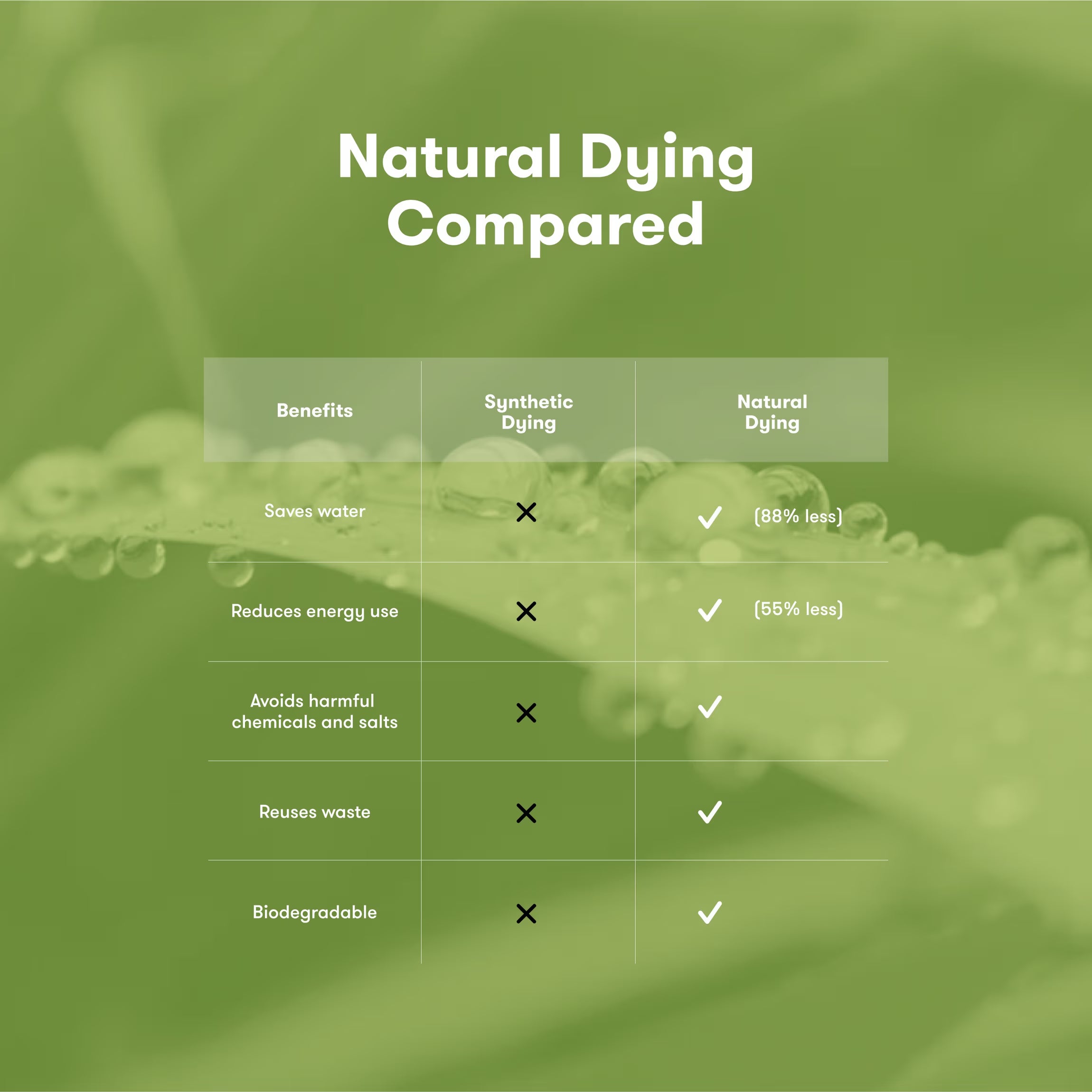
Traditional dyeing is one of the dirtiest steps in making clothes, using buckets of water and loads of chemicals that harm ecosystems and people. Ficus Innovations found a better way: a natural dyeing technique that uses plant extracts and closed-loop systems to drastically cut down on waste. Compared to synthetic dyeing, it saves 88% water and 55% energy*, all while delivering vibrant colours and being far gentler on the environment.
It’s proof that better ways do exist.
*Source: Ficus Innovation
Natural dying might not be the easiest way to color fabric.
But it's way kinder to the planet.

GETTING COLORFUL
How does it work?
While the exact process is proprietary, here's a general understanding of how it works:
1. Natural Pigment Extraction
Extract pigments from plant-based materials like olive leaves, lavender and other agricultural waste.
2. Planet-Friendly Dye Solution
Create a water-based dye bath without harmful chemicals or salts.
3. Fabric Dyeing
Submerge pre-treated fabric in the dye bath, where the pigments bind naturally to the fibers.
4. Fixation & Recycling
Make colors permanent with the help of ecological stabilizers and natural enzymes. All wastewater is subsequently reused.

WAS KOMMT ALS NÄCHSTES?
Growing gradually
We're excited to be at the forefront of this movement, proving that underwear can be both bold and responsible. But we’re just getting started. We’ve introduced a couple of items with natural dyes and prints so far and this new technique might become a bigger part of our collections. But this of course depends on the feasibility at a larger scale. And the color range we can choose from. Though…
…the future’s looking bright, naturally.
Ficus innovations proves true color comes naturally.
Without chemicals, without compromise, but with deep respect for our planet.
Other materials


